
Dice rattle, marker caps pop, and wild rules spark laughter—few activities fuse art, writing, math, and teamwork quite like making a board game from scratch.
In this guide you’ll find everything needed to run a full-day or multi-session “kid-inventor” workshop.
Why Build a Board Game Instead of Just Playing One?
1. Cross-Curricular Power
- Mathematics – Probability, geometry of paths, score-keeping, and balanced point economies.
- Literacy – Rule-book writing, story arcs, card flavor text, persuasive pitching.
- Art & Design – Layout grids, color theory, iconography, hand lettering.
- Social-Emotional Growth – Negotiation, constructive criticism, persistence through revision.
2. Growth Mindset on Tap
Kids see their first rough draft evolve into an engaging product; mistakes become version numbers, not failures.
3. Screen-Free Collaboration
The tabletop acts as a shared board game canvas, demanding real-world communication skills—no split-screen required.
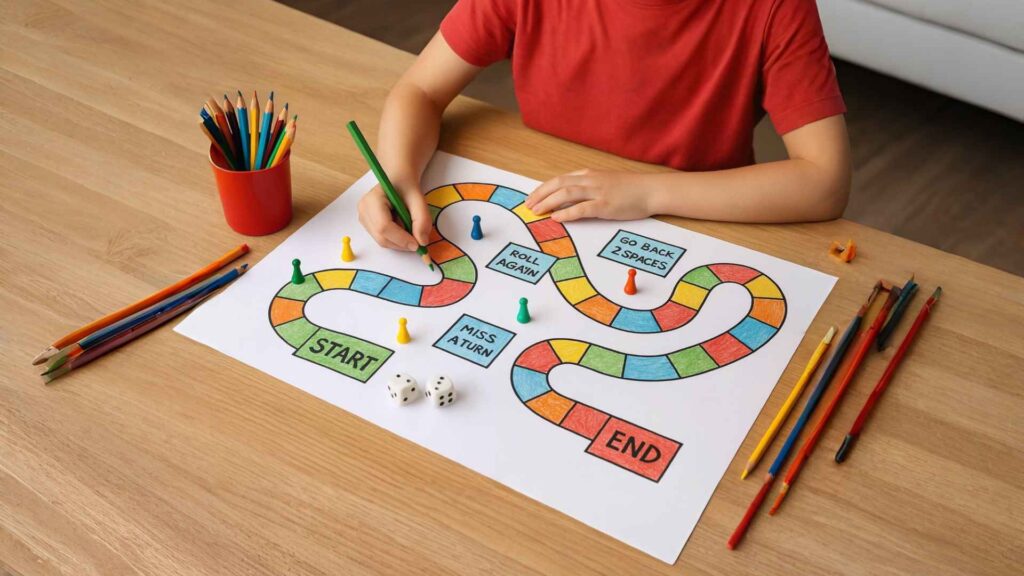
Workshop Overview at a Glance
| Station (approx. time) | Core Output |
|---|---|
| 1. Idea Storm (30 min) | Theme sheet + mechanic wish-list |
| 2. Path & Board Layout (45 min) | Pencil sketch of the play surface |
| 3. Prototype Pieces (60 min) | Cards, pawns, dice stickers, tokens |
| 4. Rule Draft & Math Check (45 min) | One-page rule sheet + sample turn |
| 5. Play-Test Round 1 (30 min) | Feedback sticky notes |
| 6. Iterate & Polish (60 min) | Revised board + clarified rules |
| 7. Final Showcase (30 min) | Mini-presentation & live play |
Total: 4–5 hours with breaks, or split across two club meetings.
Supply List for 4-6 Designers
Core paper goods
- 11 × 17 in cardstock sheets (boards)
- Index cards or A4 sheets (cut into 3 × 3 in squares for cards)
- Colored sticky notes (quick edits / feedback)
Drawing & writing
- Markers, colored pencils, fine-tip black pens
- Rulers, protractors, compass for circles
- Pencil & eraser for early sketches
Tokens & pieces
- ¾ in wooden cubes, meeples, or plastic pawns
- Blank dice or adhesive dot stickers for custom dice faces
- Bingo chips or glass gems as currency / points
- Zip bags or paper envelopes for component storage
Build aids
- Glue sticks, scissors, double-sided tape
- Laminator or clear packing tape (optional durability boost)
- Smartphone or tablet for probability calculators (teacher use)
Play-test extras
- Timer or stopwatch
- Feedback forms (printable template provided below)
- “Rule Lawyer” lanyard (kid in charge of sticking to written rules)

Station 1 – The Big Idea Storm
Brain-Gear Warm-Up
Board Game Theme Sparks
- Space rescue — astronauts marooned on a lava-spewing moon
- Jungle maze — vines that slither and reshuffle every turn
- Baking contest — pastries judged for flavor, flair, and physics-defying height
- Time travel — tweak the same scene in three different eras
- Pet hotel — pamper puppies, parrots, and ponies while chaos erupts
Mechanic Sparks
- Dice racing — roll, boost, reroll, and surge past rivals
- Deck building — earn cards, cull cards, evolve your strategy each round
- Memory match — flip tiles to uncover secret goodies and hazards
- Worker placement — assign helpers to ovens, labs, or alien lairs
- Cooperative puzzle — win or lose together against an unpredictable board
Two-Minute Brain Dump
- Hand each child a sheet filled with cloud-shaped thought bubbles.
- Start a 120-second timer. Kids scribble as many themes as possible—spelling and artistry don’t matter.
- Repeat with a fresh sheet for mechanics, encouraging action verbs such as flip, trade, bid, bluff, stack.
- Play upbeat, lyric-free music to keep the energy high.
Mash-Up Mixer — Build a First Pitch
- Pick One + One
- Each child circles one favorite theme and one favorite mechanic in bold colors.
- Glue Them Together
- Write a single-sentence concept that marries the two, for example:“A jungle maze where players draft animal cards to traverse hidden paths and outwit quicksand.”
- Stretch the Limits
- Encourage outrageous combos—“Time-traveling cupcakes powered by worker placement” might sound bonkers, but absurdity often sparks brilliance.
- Speed Sketch (optional)
- Give one minute to doodle what the board might look like—no rulers yet, just shapes, arrows, and imagination.
Elevator Pitch Circle
- 30-Second Rule
- Each board game designer stands, starts a phone timer, and delivers three beats:
- Hook — one dramatic line (“Robots are draining Earth’s oceans!”)
- Goal — what players must accomplish (“Refill the seas before turn 10.”)
- Signature Move — the mechanic that makes it special (“Powered by a memory-match energy grid.”)
- Each board game designer stands, starts a phone timer, and delivers three beats:
- Color-Card Feedback
- Green card = “I’m in—deal me a hand!”
- Yellow card = “Interesting, but tweak something.”
- Red card = “I don’t get it… yet.”
- Kids reveal cards together so feedback feels fair and fast.
- Iterate on the Spot
- For pitches that get yellow or red, each peer asks one clarifying question—no dogpiling.
- Designer chooses a fix, re-pitches in 15 seconds.
- Cycle until the idea earns mostly greens. Confidence rockets.

Station 2 – Board Layout Basics
Pencil Prototypes First
- Tools on the Table
- Plain letter or A3 paper, sharp pencils, erasers, a 12-inch ruler, and a coin for quick circles.
- Draw the Skeleton
- Decide the spine of the game:
- A loop for straightforward races
- Branching paths for exploration and choice
- Modular tiles that build outward for endless variety
- Slides and climbs for sudden leaps, à la Snakes & Ladders
- Sketch zones or rooms where major actions happen—kitchens, caves, alien labs.
- Add resource tracks along an edge for health, time, money, or temperature.
- Leave generous gaps so small fingers can move pawns without smudging the layout.
- Decide the spine of the game:
Track-Style Inspiration (no tables, just snapshots)
- Loop (classic race)
- Why kids love it: immediate sense of progress and a clear finish line.
- Design tip: sprinkle speed-boost arrows every five spaces to keep momentum high.
- Branching Paths (choose-your-own route)
- Why kids love it: meaningful choices without overwhelming rules.
- Design tip: color-code each branch so younger players can remember their journey.
- Modular Tiles (build outward)
- Why kids love it: the board feels new every session.
- Design tip: start with Post-it squares; switch to cardboard only after the flow feels fun.
- Slides and Climbs (Snakes-and-Ladders style)
- Why kids love it: surprise swings from last place to first.
- Design tip: replace snakes with thematic shortcuts—vine swings, wormholes, rainbow slides.
- Worker-Placement Grid
- Why kids love it: planning ahead and negotiating with friends feels “grown-up.”
- Design tip: begin with just three or four worker slots; add more once the group masters the basics.
Pitfall Checklist — Spot & Solve Early
- Dead Ends
- Test: trace every route with a finger—does it reconnect or exit?
- Fix: add a bridge tile, teleport square, or rotating gate.
- Too Few Spaces
- Rule of thumb: a 15-minute race needs roughly 20–30 main squares.
- Fix: weave in scenic detours that add both spaces and thematic flavor—cookie-dough crossroads, asteroid belts, jungle rope bridges.
- Inaccessible Goals
- Test: could an unlucky player rolling only ones still finish?
- Fix: include catch-up portals, resource trades, or cooperative boosts.
- Overcrowded Zones
- Test: can four pawns stand in the same square without overlap?
- Fix: double the square size or create “waiting rooms” beside busy zones.
- Icon Overload
- Test: hand the board to a peer and ask them to explain every symbol after 30 seconds.
- Fix: swap dense icons for clear colors or simple shapes, then retest.
Ink, Label, and Leave Blanks
- Once the pencil draft passes every board game checklist item, trace permanent lines with marker.
- Draw empty event squares or hexes and label them lightly (E1, E2), but save the text for later.
- Write actual event or card text on sticky notes—wording can evolve without forcing a full redraw.
- Snap a quick photo of each draft; progress pics are confidence boosters and let you roll back if a later tweak falls flat.
Facilitator Bonus: End the session with a mini “art walk.” Lay all boards on a table, let kids stroll, and ask each visitor to give one compliment and one constructive question.
The feedback stays positive, momentum stays high, and every young board game designer heads home proud of their first blueprints.
Station 3 – Crafting Prototype Pieces
Custom Dice: Turning Cubes into Story Engines
- Blank-It First
- Cover every pip on a standard six-sider with small, matte stickers; glossy labels smear under little thumbs.
- Icon Invasion
- Use ultra-fine markers to draw instantly readable images:
- ⚡ lightning bolt = speed boost
- 🐾 muddy paw print = slip backward
- 🍌 banana peel = drop a hazard token
- ⭐ star = gain a bonus card
- Remind kids that one face must stay “safe” or victories feel impossible.
- Use ultra-fine markers to draw instantly readable images:
- Test the Odds, Feel the Drama
- Roll ten quick times. Ask, “Did the scary icon show up too often?” If groans echo, replace that sticker before it’s glued forever.
- Seal the Deal(optional)
- Brush on a thin coat of clear nail polish to protect artwork from sweaty palms.
Cards on the Fly: Micro-Publishing in Minutes
- Rapid Card Stock
- Fold a sheet of cardstock into eighths, cut along the creases—instant mini cards.
- Label the Backs First
- Write “EVENT,” “ITEM,” or “POWER-UP” on the plain side so shuffling doesn’t reveal secrets.
- Crystal-Clear Front Text
- One sentence only, printed in block letters:“Ravenous vines! Skip one turn pruning.”
- Avoid fancy fonts; legibility beats style during revisions.
- Doodle Last, Not First
- After two board game play-tests confirm the wording, invite the artist to add vines, lasers, or unicorns. Cards that change each session should stay art-free until they survive the editing gauntlet.
Pawns & Currency: Tiny Objects, Big Imagination
- Meeples with Personality
- Give each wooden figure two pen dots for eyes; add spikes, fangs, or a cape. Suddenly the generic pawn is a dinosaur, robot, or pastry chef.
- Flexible Currency
- Colored plastic gems become coins, health, mana, or oxygen—decide later.
- Poker chips can stand in for both money and victory points if colors differ.
- Life-Tracker Tricks
- Stack gems beside each player; spend or lose them visibly so no one forgets totals mid-excitement.
Bag It Before It Vanishes
- Place dice, cards, and pawns in separate zip-top bags labeled with a thick marker.
- Include a spare sticker sheet and pen in each bag; mid-play tweaks happen often.
- Store bags in a clear plastic shoe box so lunch breaks don’t swallow crucial pieces.

Station 4 – Rule Draft & Math Check
One-Page Rule Sheet Blueprint
- Objective
- Start with a victory sentence written as a cheer: “Race to be the first explorer standing atop Volcano Peak!”
- Setup
- Bullet every starting item: “Each player takes 1 pawn, 3 banana cards, and 5 gems.”
- Turn Order
- Break actions into micro steps: roll → move → resolve space → draw an event card.
- Special Squares & Cards
- Describe effects as “When you land here, do X.” No wiggle words like maybe or could.
- Endgame & Scoring
- Spell out tiebreakers—kids will tie more often than you think.
- Glossary(optional)
- Define every icon in five words or fewer; glue a mini version beside the board for quick lookup.
Quick Probability Reality Check
- Roll Science, Not Guesswork
- Throw the custom die 36 times—easy multiple of six.
- Tally each icon on scrap paper.
- Compare tallies to the designer’s intent. If the trap icon shows up nine times (25 %) but kids wanted just four (≈10 %), swap a sticker and retest.
- Math Meets Emotion
- Discuss how “rare” feels vs. how rare it is. This link between numbers and excitement turns arithmetic into a design super-power.
Station 5 – Play-Test Round 1
- Blind Tester Seating
- Board game designers host at separate tables while fresh players—friends who have not heard the pitch—take the seats of critics.
- Strict 15-Minute Timer
- Short sessions force clarity; anything that drags must be trimmed.
- Three-Question Feedback Sheet
- What was fun?
- What felt confusing or slow?
- Did you invent any “house rules” on the fly?
- Observe, Don’t Defend
- Designers hold a pencil, not their tongues. They jot notes silently; no explanations until the round ends.
Station 6 – Iterate & Polish
- Sort the Notes
- Create three piles: Confusing Rules, Overpowered Cards, Boring Spaces. Sticky notes work wonders.
- Triage Each Issue
- Remove it? If a rule causes headaches, ask if the game loses anything by deleting it.
- Simplify it? Change “Roll the die and move back three unless you have rope” to “No rope? Move back three.”
- Buff vs. Nerf
- Instead of weakening the superstar card, strengthen the underdogs. Kids love upgrades more than downgrades.
- Update Components Fast
- Cover outdated squares with new sticky notes.
- Reprint cards or handwrite replacements on fresh slips; slip-in fixes beat re-designing the whole deck.
- Play-Test Again
- Run another 15-minute session. Aim for zero “Stop—what does this mean?” moments. Repeat the cycle until questions vanish.
Station 7 – Showcase & Share
Applause all around, photos with prototypes, and a reminder that iteration—not perfection—is the mark of a real game designer.
Reward every project with certificates—Best Artwork, Clever Dice, Most Cooperative, Wildest Story Twist.
Two-Minute Spotlight
Theme Hook – one punchy sentence to grab attention.
Demo Turn – walk the crowd through a single player’s move so board game rules click instantly.
Sell the Sizzle – highlight the zaniest mechanic or funniest card; passion is contagious.
Audience Reaction Tokens
Each spectator raises a green chip for “I’d play it!” or a yellow chip for “Needs polish.” Quick board game visuals spare feelings and spark dialogue.
Celebrate Every Design
Hand out playful certificates:
- Best Artwork
- Clever Dice Creation
- Most Cooperative Gameplay
- Wildest Story Twist
Extending the Board Game Workshop
Curriculum Tie-Ins
Ancient Civilizations
- Ask students to recreate Silk-Road trading, Viking raids, or Egyptian mythology as game loops.
- Require at least two historically accurate resources (e.g., papyrus, amber, grain) and one real-world barrier such as taxes or piracy.
- Finish with a five-minute “historian’s minute” where the designer explains what really happened and what the game bends for fun.
Math Class
- Challenge players to calculate the expected value of each power-up card by multiplying probability and payoff.
- Hold a “probability auction”: kids bid gems on the card they believe is most efficient, then reveal the math together.
- Introduce basic spreadsheets or calculators to show how designers and publishers forecast fairness.
Language Arts
- Assign marketing blurbs (“Back-of-Box Hook”) limited to 40 words; peer review them for clarity and excitement.
- Convert board game rule sheets into how-to narratives that use active voice and second person (“On your turn, draw one card…”).
- Practice persuasive writing by drafting a Kickstarter pitch paragraph and reading it aloud with dramatic flair.
Digital Upgrade
- Photograph the pencil prototype from directly overhead to avoid distortion.
- Import the image into a free vector tool such as Inkscape, Boxy SVG, or Gravit Designer.
- Trace clean lines, swap pencil icons for crisp clip-art, and add a color palette that meets contrast guidelines.
- Export the board and card sheets as high-resolution PDFs, then upload to a print-on-demand service (e.g., The Game Crafter, BoardGamesMaker) for a real boxed edition.
Community Night: “Family Game Café”
- Invite List — classmates, siblings, neighbors, grandparents; diversity of ages uncovers hidden clarity issues.
- Café Atmosphere — arrange small tables, play gentle background music, and offer snacks that keep hands dry (pretzels, popcorn).
- Feedback Loop — place a comment card and pen at every seat; collect them in a decorated “idea box.”
- Charity Twist — auction the evening’s crowd-favorite prototype; donate proceeds to the school library or a children’s hospital.
Safety & Material Tips
- Provide blunt-tip, child-safe scissors and washable, non-toxic markers only.
- Enforce a “dice stay on the table” board game rule to prevent slip hazards.
- Laminate final boards or cover them with clear contact paper if drinks are allowed near play areas.
- Save all paper off-cuts in a labeled bin—instant sketch pads for the next brainstorm session.
Frequently Asked Questions
- Can my board game be any size?
Yes, but practical limits matter: larger than 18×18 inches won’t fit most kitchen tables. Trim edges or add modular tiles if you run out of space. - Square versus hexagonal spaces—what’s the difference?
Squares create straightforward, 90-degree movement; hexes allow six movement directions and feel more organic but complicate counting for younger kids. - What’s the best age to start experimenting with custom dice?
Around eight years old, when children grasp probability basics and can handle small stickers without peeling frustration. - May we share intellectual property from movies or games we love?
Only as private classroom projects. Publicly distributing or selling requires original art or licensed permission. - How do we balance luck and strategy?
Mix a randomizer (cards or dice) with at least one meaningful player choice each turn so decisions—not just rolls—decide the winner. - What if the game never ends?
Add a turn cap (e.g., 15 rounds) or a sudden-death condition such as “first to 50 points or most points when the draw pile empties.” - Our card text is a paragraph—how can we shorten it?
Replace clauses with icons, move edge cases to the glossary, and aim for one action verb plus one consequence. - How many play-tests are enough?
Minimum three blind tests with fresh players each time; stop when observers ask zero rule questions. - Players keep arguing—how do we handle disagreements?
Install a “one-minute sandbox” rule: pause, each side explains once, group votes, majority decision stands for the rest of the session. - Cardstock or lamination for printing?
Heavy cardstock is cheaper and easier to mark up; laminate only when the wording is final. - How do we choose a color-blind-friendly palette?
Use high-contrast pairs like blue-orange or purple-yellow and add shapes or icons so color alone never carries information. - Can we re-theme the game without redrawing the board?
Yes—cover art and text with removable labels and swap meeples or tokens that better match the new story. - Cheapest pawn substitutes?
Paper clips bent upright, dried beans, LEGO minifigures, or buttons all work in a pinch. - How do we avoid copyright infringement in artwork?
Draw original characters or use public-domain images; never copy mascots or logos directly. - How can silent or shy students contribute?
Give a private feedback journal or digital form so they can write comments instead of speaking. - Keeping younger siblings engaged while older kids design?
Hand them coloring sheets of game elements or let them roll dice for probability tests. - What’s the best way to store fragile prototypes?
Pizza boxes or flat art portfolios keep boards flat; zip bags divide cards, dice, and pawns. - Can any competitive game become cooperative?
Usually: introduce a shared timer, collective resource pool, or common enemy deck that all players fight together. - Is it worth adding a companion app?
Only if it automates bookkeeping or narrates story events; avoid tech for tech’s sake. - How do we speed up slow turns?
Use simultaneous planning (everyone chooses a card face-down), limit analysis time with a sand timer, and remove edge-case rules. - Penalty loops are ruining the fun—fixes?
Replace repeated setbacks with temporary ones; let players pay gems to escape or gain a small bonus after the penalty to soften the blow. - Which fonts read best in a rule book?
Sans-serif like Arial or Helvetica at 11-point for body text; keep headings under three font faces total. - Can this double as a graded math project?
Absolutely—submit probability charts, expected-value tables, or cost curves as evidence of applied mathematics. - How do we pitch a finished game to a local toy store?
Bring a play-ready sample, a one-page sell sheet with age range, player count, and wholesale price, and schedule a visit—never cold-walk in. - Designing expansions—where do we start?
Identify one question: “What do fans want more of—story, options, or difficulty?” Then add modular packs that plug into the existing system without rewriting the core rules.
Final Encouragement
When kids realise that the weird doodle they sketched in homeroom has morphed into a real board game their friends beg to borrow, they experience a creator’s thrill few digital entertainments can match.
Every colored square, silly penalty, and balanced die face binds together math facts, storytelling flair, and the joy of working toward a shared goal.
So clear the dining table, uncap the markers, and let young imaginations roll the dice—because the best family night you’ll have this year might start with an empty sheet of cardstock and a single question: “What if the board game we want doesn’t exist yet?”

