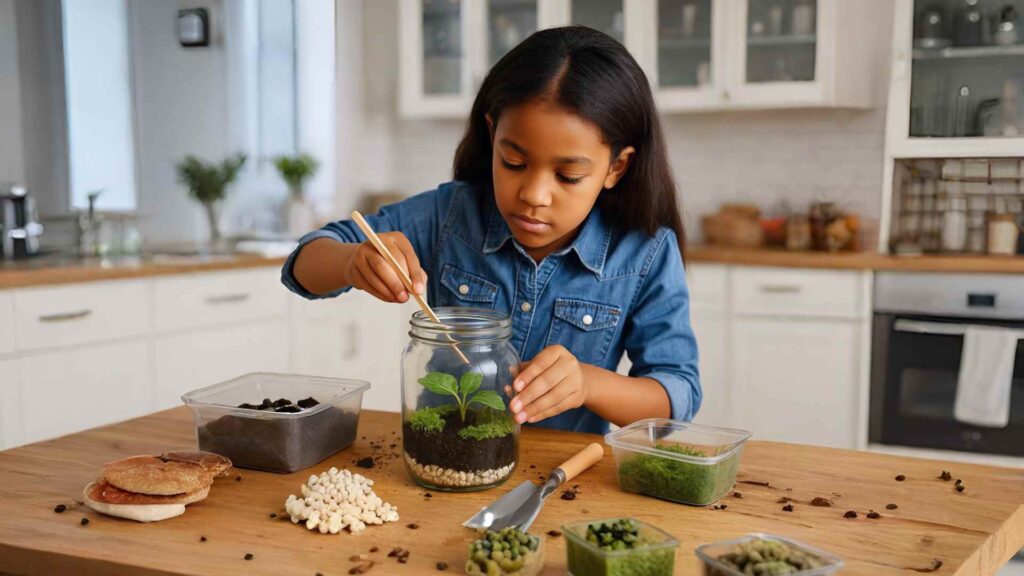
Building Closed-Terrarium Ecosystems With Kids: Fun Mini-Worlds!
Sun-warm glass, secret moss forests, a rainstorm that never leaves the kitchen table—closed terrariums shrink Earth’s most important cycles into reach of small hands.
This guide walks families from science basics to long-term care, turning every sealed jar into a living lesson that glows for years.
Closed terrariums are self-sustaining ecosystems: water evaporates, condenses, and “rains” back; plants trade oxygen and carbon dioxide in daily photosynthesis-respiration loops; microorganisms recycle nutrients.
Benefits at a glance – sharpen observation skills, sneak in applied botany, teach responsibility, and add screen-free wonder to a shelf.
The Science at Work — Earth’s Big Cycles in Pint-Size Form
1. Micro-Water Cycle: Rain Cloud in a Jar
Evaporation & Transpiration
Morning warmth lifts water from damp soil and from microscopic pores (stomata) on leaf undersides.
Vapor rises until it meets the cooler inner wall of the glass.
Condensation
The glass surface acts like a mountain peak at dawn; vapor cools, clings, and forms visible beads.
Droplets merge, grow heavy, and trickle back as “rain,” soaking the soil once more.
Self-Regulation
The cycle slows overnight when temperature drops and plant transpiration ceases, preventing flood.
A stable terrarium shows heavy beads at sunrise, clear glass by mid-afternoon.
2. Gas Exchange Ballet: Breathing Without Lungs
Daylight Photosynthesis
Chlorophyll absorbs photons, using their energy to combine carbon dioxide with water, releasing oxygen.
Photosynthesis pauses in darkness; plants and microbes then consume some of the stored sugars, taking in oxygen and exhaling carbon dioxide.
Balancing Act
A jar with roughly one-third foliage and two-thirds empty air volume usually maintains safe CO₂ / O₂ levels.
Excess foliage? Oxygen may dip on long winter nights—trim leaves that press against the glass to restore equilibrium.
3. Nutrient Recycling Loop: The Invisible Garden Crew
Leaf Litter Falls
Older leaves yellow, drop, and rest on the soil surface.
Detritivore Action
Springtails, isopods, and microscopic mites shred litter into confetti.
Bacterial & Fungal Breakdown
Decomposers convert shreds into mineral ions—nitrate, phosphate, potassium—dissolved in the terrarium’s film of moisture.
Root Uptake
Fine root hairs absorb the freshly freed nutrients, powering new shoots that will someday fall and restart the loop.
Energy Source
The only external input is sunlight; every gram of matter stays inside, cycling endlessly.
4. Hands-On Extension: Build a Cycle Wheel
Place the wheel beside the jar; invite daily notes on what stage is visible. Over weeks, children see that all arrows eventually point back to the start, proving their mini-world really is a closed system.
Draw a large circle on card stock; divide it like a pie into Water, Gas, Nutrients.
Under each slice, sketch key stages—evaporating droplet, CO₂ arrow, decomposing leaf.
Attach a brad fastener and top pointer arrow so kids can spin to “track” which process they observe—morning condensation, afternoon photosynthesis, or weekend leaf fall.
Safety & Prep
Glass jars with rubber gasket lids seal best yet let adults “burp” excess humidity.
Wash vessels in hot soapy water; rinse to avoid soap residues that harm moss.
Use activated charcoal—sold for fish tanks—to adsorb odours and slow bacterial bloom.
Young builders wear garden gloves; glass edges can nip.
Shopping List (per 2 L jar)
Container: 1 × clear glass jar with lid.
Drainage: 1 cup pea gravel or LECA.
Barrier: 1 square coffee filter or landscape fabric.
Charcoal: ⅓ cup activated carbon.
Soil: 2 cups sterile, peat-free houseplant mix; blend equal parts coco coir, perlite, and worm castings.
Plants: 3–5 humidity lovers (see next section).
Hardscape: fist-size rock, twist of grapevine, or miniature figurine.
Cleanup crew (optional): pinch of springtails/isopods.
Tools: chopsticks, long tweezers, mist bottle, funnel made from paper cone.
Lay supplies out on a tray so kids can see ecosystem “layers” before stacking them.
Choosing the Right Green Residents
A sealed terrarium behaves like a miniature cloud forest: temperatures hover in the low-to-mid 20 °C range, air barely stirs, and humidity hovers near 90 percent.
That cozy steam room is paradise for understory jungle plants—but a death sentence for succulents and other desert natives.
Before you bring home any greenery, run it through three quick checkpoints:
Compact stature Anything that can grow taller than about 15 cm will soon press against the glass and shade its neighbors.
Moisture tolerance Roots must enjoy permanently damp soil; plants that “like to dry out” will rot.
Low-light ease The jar will never receive full sun, so pick species that flourish on bright, indirect light.
Ask children to imagine they are real-estate agents matching “tenants” to a humid studio apartment—size, lifestyle, and lighting all have to fit.
Kid-Approved Terrarium Plants
Nerve Plant ‘Pink Angel’ (Fittonia albivenis) Neon-pink veins pop against dark green leaves and stay bushy at 8–12 cm. The foliage wilts dramatically when thirsty, giving kids a living reminder to check moisture.
Mini Watermelon Peperomia (Peperomia argyreia dwarf form) Broad, striped leaves store moisture yet tolerate constant damp. Growth is deliberately slow, so pruning is rare.
Silver Sparkle Pilea (Pilea glauca ‘Aquamarine’) Forms a soft, trailing mat of silvery-blue leaves that drape over rocks without smothering taller companions.
Dwarf Boston Fern (Nephrolepis exaltata ‘Fluffy Ruffles’) Sturdy fronds arch outward but rarely exceed 12 cm. Children can press trimmed fronds between wax paper for bookmarks.
Silver Lace Fern (Pteris ensiformis variegata) White midribs look like snowflakes scattered across each leaflet; loves the terrarium’s perpetual humidity.
Mood Moss (Dicranum species) Cushions the soil surface, absorbing runoff and redistributing it during drier spells. Great for creating “hills” and “riverbanks.”
Sheet Moss (Hypnum cupressiforme) Clings to rocks or even the glass wall, forming a vertical curtain of green and adding depth to the scene.
Tip for budding botanists: Encourage kids to copy the Latin name from each plant’s tag into a notebook. Scientific names are like international passports—they never change at the border, even when common names do.
Optional Micro-Fauna: Nature’s Janitors
A closed jar can sprout fuzzy mold whenever a leaf dies. Adding a tiny cleanup crew keeps the ecosystem in balance.
Springtails (Collembola)
Look & size Pinhead-sized, pale gray “jumpers” that can spring several body lengths.
Role Graze on mold spores and leftover pollen, preventing fungal outbreaks.
How to add Tip a teaspoon of their culture (usually charcoal or moist clay granules) onto the moss, then mist lightly.
Dwarf White Isopods (Trichorhina tomentosa)
Look & size Miniature pill bugs, 4–6 mm long, pure white.
Role Shred fallen leaves and tunnel just under the soil surface, aerating the substrate and recycling nutrients.
How to add Place five to ten individuals near a chunk of wood or under a leaf-litter pinch so they have immediate shelter.
Care Notes for the Crew
Rinse cultures in de-chlorinated water to remove any fertilizer granules before introduction.
Skip chemical fertilizer or pesticide sprays—these tiny arthropods are the first to suffer.
If populations explode, simply scoop a few residents into a new jar or offer them to any reptile-keeping friends as nutritious live food.
When to Add—or Skip—the Critters
Add both springtails and isopods if your design includes plenty of leaf litter and humidity stays consistently high.
Add springtails only if the jar is mostly moss with minimal decaying material.
Skip fauna altogether if the terrarium is decorative first (lots of figurines, very little soil coverage); they will starve without a steady supply of organic debris.
By pairing the right moisture-loving plants with an efficient micro-janitorial staff, kids don’t just build a pretty scene—they assemble a self-regulating community where every dead fragment becomes tomorrow’s plant food, exactly as it does on the rainforest floor.
Build-Day Walk-Through — From Empty Jar to Pocket Rainforest
Set aside about 90 minutes from first gravel pour to final wipe-down. One adult guides, kids do the scooping, misting, and artistic calls.
1. Drainage Layer — The Jar’s Sump Pump
Spread newspapers or a baking sheet under the workspace; gravel can bounce.
Hand each child a small cup of rinsed pea gravel or LECA. Let them funnel it in until the layer reaches roughly two fingers deep (2–3 cm).
Tip the jar sideways and roll the gravel so it lies level—demonstrate how stones create air pockets that trap excess water and keep roots from drowning.
Knock the jar gently; the clink tells kids the floor is solid and even.
2. Carbon Filter — The “Smell Sponge”
Cut a coffee filter or scrap of landscape fabric into a circle just wider than the jar bottom.
Press it flat over the gravel. Explain that this sheet stops soil from sifting down and muddying the reservoir.
Sprinkle a loose handful of activated charcoal pellets evenly across the fabric. Have kids sniff—charcoal’s porous surface locks away odours and slows bacterial bloom.
3. Substrate — Good Dirt, Great Slope
Pre-mix potting blend in a bowl (equal coco coir, perlite, worm castings).
Roll a paper cone, slide it into the jar, and let children spoon soil through the funnel. This prevents dusty fingerprints on the glass.
Build the layer 4–6 cm deep, mounding slightly higher toward the jar’s rear wall. Mention the movie-set trick called “forced perspective”: higher back soil makes the scene look deeper.
Mist with a spray bottle until the top darkens and clumps when pinched—not so wet that water glistens in the gravel below.
4. Hardscape & Layout Rehearsal — Designing the Landscape
Offer several rocks, a piece of driftwood, or a whimsical figurine.
Slide the largest item in first with long tweezers; this becomes the landscape’s anchor.
Use chopsticks to wiggle it until it sits one-third from the back—prime “rule-of-thirds” positioning draws the eye.
Rotate the jar 360 degrees so children can vote on which face looks most like a cliff, bridge, or ancient ruin. This rehearsal saves headaches later when plants block maneuvering room.
5. Planting — Layering the Green Cast
a. Moss Carpet
Tear your terrarium moss into palm-sized pieces. Press each patch onto the soil like peel-and-stick turf, making sure the green side faces up.
b. Main Foliage Plants
Have kids poke shallow divots with a finger or pencil.
Slip root balls in, gently firm soil around them. Whisper “tuck the babies in”—they remember to cradle roots, not cram.
c. Accent Seedlings
Add low creepers or silver-leaf accents around the base of wood and between rocks. These fill gaps and hide bare soil.
Finally, hand a soft brush or microfiber cloth to a helper. Wipe away stray soil grains and fingerprints so the glass becomes an invisible window into the world just created.
6. Micro-Fauna & Mulch — Bringing in the Janitors
Tap springtail culture onto the moss—tiny specks scatter like ground pepper.
Crumble a single dried oak or magnolia leaf over the soil as first meal.
If using dwarf isopods, place them in the shadiest corner under a scrap of leaf so they can acclimate.
7. First Mist, Seal, and Placement
Give three to four fine spritzes until a light sheen coats foliage and glass.
Seat the coin-cell–sized humidity gauge if you’re using one.
Close the lid firmly; listen for the faint rubber-gasket hiss that means moisture is locked in.
Carry the terrarium to a spot that gets four to six hours of bright, indirect light—an east-facing sill behind sheer curtains or a shelf under an LED lamp.
Step back. Tiny clouds will form on the glass within the hour—proof the water cycle is already alive.
Quick Cleanup & Celebration
Snap a “family with terrarium” photo for the observation journal—and officially welcome your new mini-world to the household.
Sweep spilled gravel back into a jar labelled “future builds.”
Rinse funnels and chopsticks; let them air-dry in the sun.
The Critical First Month — Getting Past the “Wobble Stage”
A brand-new terrarium behaves like a newborn: humidity swings, microorganisms bloom, and plants adjust their internal clocks.
Most jars calm down in about 30 days, but that first stretch needs watchful—yet gentle—hands.
Days 1 – 7 Fine-Tuning the Water Cycle
Morning check: If the glass is so foggy you can’t see the plants, pop the lid for an hour. The extra vapor escapes, roots keep breathing.
Afternoon check: By lunch, the glass should look mostly clear except for a few glittering beads. If it’s bone-dry, drizzle in one teaspoon of de-chlorinated water, reseal, and observe the next morning.
Kid task: Mark a blue droplet sticker on their chart whenever heavy condensation appears; a yellow sun for clear mornings.
Days 8 – 14 Balancing the Micro-Zoo
Mold patrol: Light cottony fuzz on soil or leaf tips signals excess organics. Gently blow to confirm—if the fuzz floats like smoke, it’s mold.
Response plan: Add another pinch of springtails, then crack the lid 30 minutes a day for the next three days to raise oxygen and drop humidity.
Kid task: Draw a tiny magnifying-glass icon whenever mold is spotted and note the “treatment” beside it.
Days 15 – 30 Reading Plant Body Language
Leaf color clues:
Pale or stretched leaves → jar sits too far from light; shift it closer or add an LED strip.
Crispy brown patches → direct sun is cooking tender tissues; scoot the jar at least 30 cm back or add a sheer curtain.
Growth spurt check: If a stem tries to escape through the lid, pinch it back by a third. Leave the trimmings inside; they’ll decompose and feed the soil.
Kid task: Use a green sticker for “happy” leaves and an orange one next to any troubleshooting note.
After a month of charting, kids will see fewer and fewer terrarium special-event stickers—evidence their mini-world has achieved self-balance.
Long-Term Care — Low Effort, High Reward
Condensation rule of thumb: Morning droplets + afternoon clear view = gold standard. If fog lingers all day, crack the lid for 48 hours; if the glass never sweats, add two teaspoons of water and watch again.
Watering frequency: A healthy, balanced jar may not need another drink until seasonal heating dries indoor air—often just two or three times per year.
Quarterly pruning: Snip any leaf that presses against the glass; let the clipping fall to the soil—it becomes slow-release fertiliser.
Seasonal light shuffle: In winter, move the jar away from radiators or wood stoves. Each month give the vessel a quarter-turn to prevent phototropism from creating a lopsided “lean.”
Bi-annual “burp”: Open the lid for five minutes at spring equinox and again at autumn equinox. Fresh air resets trace-gas balance without upsetting humidity.
Remember David Latimer’s famous bottle garden—unopened for decades yet still thriving. Your jar can aim for the same marathon with just these tiny interventions.
Troubleshooting & Smart Hacks
Persistent Fog
Lift the lid and drape cheesecloth over the opening for 24 hours. Moisture escapes, but tiny gnats can’t enter.
Mold on Leaves
Increase light by moving the jar closer to a window.
Dab affected spots with a cotton swab dipped in one-part hydrogen peroxide to ten-parts water.
Boost the cleanup crew with an extra sprinkle of springtails.
Mushy Stems
Likely over-watering at setup. Twist a paper-towel strip into a wick, insert one end into the soggy soil and drape the other over the rim. After 48 hours the wick will have drawn out the excess; remove it and reseal.
Hidden Moisture Gauge
Slide a 10 cm bamboo skewer down the back wall during setup. Darkened wood shows how far moisture climbs; when the top half stays pale for a week, you know it’s time for a teaspoon of water—no guessing.
With these detailed checkpoints, gentle corrections, and clever monitoring tricks, even first-time young botanists can guide their glass-jar rainforest from its wobbly beginnings into a stable, years-long showcase of Earth’s elegant cycles.
Learning Extensions
Observation Journal
Record daily temp, light hours, condensation pattern, new leaf count—kids graph data to link environment changes to growth.
Mini-Experiments
Light variable: twin jars 1 m and 3 m from window; compare growth.
Plant diversity: one monoculture moss jar vs. mixed-species jar—note stability.
CO₂ pulse: exhale into jar for 10 s, reseal, track pH of condensation.
Storytelling & Art
Draw “explorer’s map” of jar interior; name landmarks: Mist Mountain, Fern Falls.
Frequently Asked Questions
1. How big should the jar be? Anything from a 500-millilitre spice jar to a ten-litre carboy will work; a larger vessel buffers temperature and humidity swings, making success easier for beginners.
2. Does glass thickness matter? Regular jam-jar glass is fine. Extra-thick display bottles just add weight and visual distortion; they don’t change the internal climate.
3. Can we use garden soil straight from the yard? You can, but bake it at 180 °C for 30 minutes to kill insect eggs and weed seeds. Sterile, peat-free potting mix is the safer plug-and-play choice.
4. Is activated charcoal really necessary if I’m adding springtails? The tiny insects recycle organics; charcoal adsorbs odours and stray chemicals. Using both gives the most stable, sweet-smelling ecosystem.
5. Do I need a drainage layer in small jars? Yes. Even in a teacup-sized build, two centimetres of pea gravel or LECA prevents roots from sitting in stagnant water.
6. How much light is ‘bright, indirect’? Place the jar where you could comfortably read a book without switching on a lamp, but where direct sunbeams never hit the glass. An east or north window is perfect.
7. Can I use a grow-light instead of a window? Absolutely. Position an LED grow panel 30–40 cm above the lid and run it eight to ten hours a day to mimic a springtime sun.
8. How often will I need to water? After the initial misting, a balanced jar may not need another drink for six months—or even longer—if condensation appears every morning and clears by afternoon.
9. What if the glass stays foggy all day? Crack the lid open for 24–48 hours to let excess moisture escape. If fog returns immediately, use fewer mists next time.
10. What if the glass never fogs? Add one or two teaspoons of de-chlorinated water, reseal, and check again the following morning.
11. Why did a plant suddenly collapse into mush? Root rot from over-watering or prolonged darkness is the usual culprit. Remove the remains with tweezers, improve light exposure, and replace with a cutting.
12. Can I grow seeds in a closed terrarium? Tiny fern spores or moss gemmae thrive, but most flowering seeds shoot up too tall. Start seedlings elsewhere and transplant dwarf selections once they have mature leaves.
13. Do terrariums attract pests? Well-sealed jars rarely do. If fungus gnats slip in, adding more springtails and a yellow sticky trap near the jar usually ends the invasion.
14. Can I keep insects or snails inside? Small micro-arthropods like springtails and dwarf isopods are fine; snails, millipedes, and pill bugs often over-graze foliage, so they’re best avoided.
15. Should I fertilise the plants? No liquid fertiliser: it spikes algae and mold. Fallen leaves and the clean-up crew create a built-in slow-release nutrient cycle.
16. How do I clean fingerprints off the inside glass? Use a narrow microfiber cloth taped to a chopstick. Never spray cleaners inside—chemicals can harm moss and microfauna.
17. Do I ever have to open the lid again? Burp the jar for five minutes twice a year (spring and autumn) to refresh trace gases; otherwise, let the ecosystem run itself.
18. Why is green film growing on the gravel? Algae flourish when light hits standing water. Reduce light intensity or slip a decorative strip of opaque paper around the base to shade that zone.
19. Can the terrarium live in my child’s bedroom? Yes—as long as the room stays above 15 °C and you keep the jar away from heating vents that can cook the plants.
20. My moss turned brown—did it die? Probably just dry or adjusting. Mist once, move the jar slightly closer to light, and wait two weeks; many mosses re-green from the centre outward.
21. How do I stop vines from taking over? Pinch back tips every few months. Toss trimmings onto the soil—they’ll rot down into fertiliser.
22. What’s the longest a terrarium can survive? Well-balanced bottle gardens have lasted decades with no new water—proof that, once cycles stabilise, the system can run almost indefinitely.
23. Can I paint the outside of the jar? Sure, but leave at least one clear window so you can monitor condensation and plant health.
24. Will coloured LEDs change plant growth? Blue-heavy bulbs keep foliage compact and green; red can make leaves larger but paler. A balanced white grow-lamp is the safest all-round choice.
25. Is it possible to restart if everything goes wrong? Definitely. Empty the jar, rinse with hot water, rebuild the layers, and reuse any healthy moss or rocks. Each rebuild teaches new lessons in tiny-world ecology.
Final Encouragement
Inside every closed terrarium, water whispers upward, sunlight forges sugars, and an invisible clean-up crew shuffles dead into nourishment.
When kids build that universe themselves—layer by pebbly layer—they witness stewardship in miniature.
Place the sealed jar on a sill, tilt it to catch morning gold, and watch tiny forests thank you with unfurling fronds. Earth’s grand lessons now fit in your hands—keep them bright, and they’ll glow back for years to come.