
Your kid says “five more minutes” for the fourth time, and you are googling this question at midnight, again.
Here is what actual pediatricians and researchers say about how much screen time is too much, broken down by age, plus what actually helps.
What the Experts Actually Recommend, By Age
Short answer: it depends on your kid’s age, and the guidelines get more specific the younger they are.
The two most cited sources are the American Academy of Pediatrics and the World Health Organization, and they land in roughly the same place even when the wording differs.
For kids under 5, there is a real number you can write on the fridge.
For kids over 6, the guidance shifts from a stopwatch to a bigger question: what is the screen time actually replacing?

Babies and Toddlers Under 18 Months: Basically None
For babies younger than 18 months, the AAP and the World Health Organization say the same simple thing: keep screens out of the picture.
The one common sense exception is video chatting with a grandparent or a traveling parent, since that is a real relationship, not passive viewing.
This is not about screens being evil. Babies this age are wiring their brains through faces, touch, and back and forth interaction, and a screen cannot really do that yet.
If your baby watches you video call Grandma twice a week, you are not breaking any guideline. Relax.
18 Months to 2 Years: A Little, Always Together
Once your toddler hits 18 months, the guidance loosens slightly. High quality shows, watched together, become okay in small doses.
The key word there is together. Co-viewing means you narrate what is happening, point at the dog on screen, and connect it to the actual dog you saw at the park.
Preschoolers Ages 2 to 5: About One Hour a Day
This is the age where the guidelines finally hand you a real number: no more than one hour a day of high quality programming.
That is the American Academy of Pediatrics recommendation, and the World Health Organization lands in nearly the same place for children ages 2 to 4.
One hour is a ceiling, not a goal. Less is genuinely fine, and nobody is knocking on your door if your kid watches 45 minutes instead of 60.
You can find the full breakdown on the AAP’s screen time guidelines by age if you want it printed out.
School-Age Kids 6 to 12: Why There Is No Magic Number Anymore
Here is what surprises a lot of parents: for kids 6 and older, the AAP stopped publishing one universal hour limit years ago.
The research simply did not support a single number that fits a shy 7 year old and a chatty, extroverted 11 year old equally well.
Instead, the current advice focuses on quality and balance: is media use crowding out sleep, movement, homework, and actual friendships?
That shift can feel frustrating if you wanted a clean rule to enforce. It also happens to match how most families actually experience screen time, which is messier than a single number ever could be.
What Kids Are Actually Getting (The Real Numbers Are Sobering)
Instead of a hard limit, here is what kids are actually clocking in real households, according to recent survey data cited by the AAP.
- Toddlers ages 2 to 4: about 2 hours and 8 minutes of media a day
- Early childhood ages 5 to 8: about 3 hours and 38 minutes a day
- Tweens ages 8 to 12: about 5 hours and 33 minutes a day
- Teens ages 13 to 18: about 8 hours and 39 minutes a day
Those figures cover entertainment media, not schoolwork or the occasional video call with a friend across town.
If your kid’s numbers look higher than that, you are not alone, and spiraling about it will not help either of you.
Teenagers 13 to 18: More Hours, Same Underlying Question
Teens are the group parents worry about most, and honestly, that worry is not unreasonable.
Phones are built to be checked constantly, and most teens now carry one everywhere they go, including to bed.
The AAP does not set an hour limit for teens either. It instead asks families to notice whether screens are crowding out sleep, exercise, homework, and face to face time.
A teen who games for three hours on a Saturday but still sleeps well, sees friends in person, and keeps their grades up is in a very different spot than one who is not doing any of that.
Why “Too Much” Isn’t Really About the Clock
Here is the honest truth hiding under all those hour recommendations: two kids can watch the exact same 90 minutes and have completely different experiences.
One kid watched an educational show with a parent narrating along, then went outside after. The other kid scrolled short videos alone in bed until 11pm and woke up wrecked.
Researchers increasingly care less about the number on the clock and more about three things: what your kid is watching, whether they are watching with you, and what that time is replacing.
The Warning Signs That Matter More Than a Timer
Instead of asking “how many hours,” pediatricians increasingly suggest asking questions like these instead.
- Is screen time crowding out sleep, physical activity, or in person friendships?
- Does your child melt down disproportionately when a screen turns off?
- Is a screen the only thing that reliably calms big emotions, every single time?
- Is your child sneaking screens or lying about how much they used?
If you answered yes to two or more of those, the total hours matter less than what is happening underneath them.
Sleep Is Where Screen Time Does the Most Damage
If there is one place the research is nearly unanimous, it is sleep.
A review of youth screen habits published in the journal Pediatric Clinics found real benefits to keeping devices out of bedrooms and powering them down 30 to 60 minutes before lights out.
That single change, no devices overnight in the bedroom, tends to matter more than the total hours used earlier in the day.
Blue light plays a small role, but the bigger issue is usually that a phone glowing in a dark room is genuinely hard to put down.
A charging station in the kitchen or hallway, far from any bed, solves more sleep fights than any app blocker ever will.
A Simple Age-by-Age Cheat Sheet You Can Actually Use
If you want the short version to screenshot, here it is.
- Under 18 months: avoid screens, except video chatting with family
- 18 to 24 months: a little, always watched together
- 2 to 5 years: about one hour a day of high quality, co-viewed content
- 6 to 12 years: no fixed number, watch sleep, activity, and mood instead
- 13 to 18 years: no fixed number, protect sleep and in person time first
Tape it inside a cabinet, whatever helps you stop relitigating the rule every single afternoon.
What to Do Instead of Watching the Clock
Rules are easier to hold onto when there is something appealing on the other side of them.
Boredom is not a problem that needs solving immediately. A little of it is actually good for a developing brain.
When my own kid used to announce “I’m bored” like it was a five alarm fire, I learned to treat it as an opening instead of an emergency, and you can find a whole approach to that exact moment here.
Simple, screen free options do the heavy lifting, and they do not need to be Pinterest worthy to work.
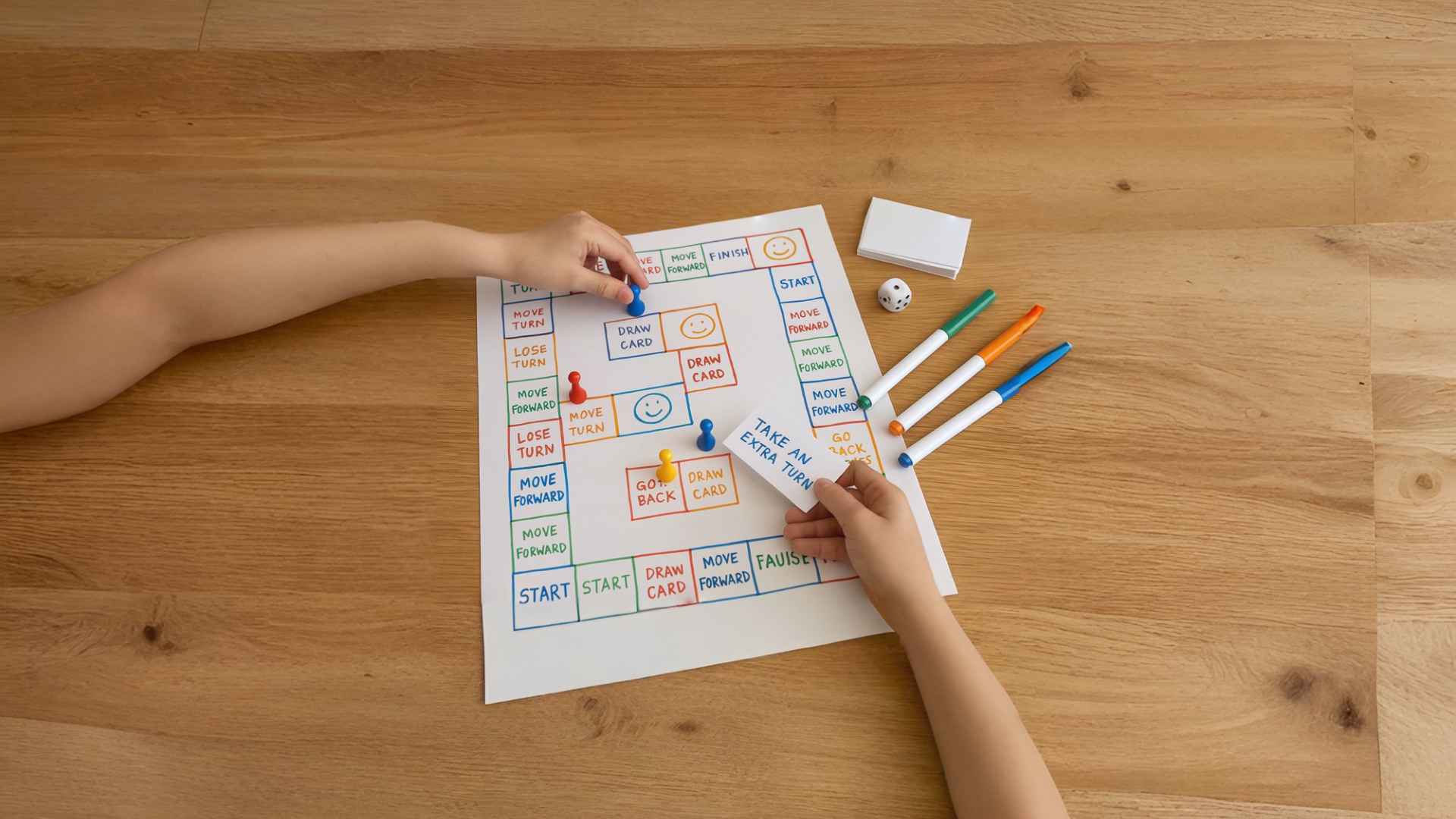
A cardboard fort, a deck of cards, or twenty minutes outside often resets a rough afternoon faster than any negotiation over minutes ever will.
Keep a short list of these on hand for the exact moment a screen gets turned off and the whining starts. Having the next thing ready matters more than the rule itself.
Building a Family Media Plan That Does Not Start a War
The AAP actually has a free tool for this exact problem: a personalized family media plan you build together instead of announcing from on high.
Kids as young as 6 or 7 can help set their own rules, which makes them far more likely to actually stick to them.
Keep it boring and specific: no phones at the table, screens off an hour before bed, weekend mornings stay screen free until breakfast is done.
Boring rules survive. Vague ones get renegotiated in real time by a surprisingly persuasive 8 year old, so if you want a fuller walkthrough, this beginner’s guide to screen free parenting lays out the whole process.

Frequently Asked Questions
What is the AAP screen time recommendation by age? Roughly: avoid screens before 18 months except video chatting, introduce a little together between 18 and 24 months, cap it at about one hour a day of high quality content from 2 to 5, and after age 6 focus on balance and quality rather than a strict hour limit.
Is 2 hours of screen time too much for a 10 year old? Not automatically, since the average tween is actually closer to five and a half hours a day, so what matters more than the raw number is whether sleep, activity, and friendships are still intact.
Does screen time cause ADHD? Research shows a correlation between heavy screen use and attention difficulties in some kids, but most experts point to lost sleep and lost active play time as the bigger contributing factors rather than proven direct causation.
Is 4 hours of screen time a day bad for a teenager? Not necessarily on its own, since pediatricians generally care more about whether that time is crowding out sleep, exercise, and in person connection than about the raw hour count.
What actually counts as screen time? Most guidelines mean recreational, passive use like TV, videos, gaming, and social media, not video chatting with relatives, active learning apps used with a caregiver, or homework done on a laptop.