
Every “put down the tablet” argument gets easier once you have the research on your side, not just your gut feeling.
So we pulled the actual studies and expert guidelines on outdoor play and organized them into one place you can actually use.
What “Outdoor Play” Actually Means in the Research
When researchers talk about outdoor play, they are not usually talking about a scheduled soccer practice or a nature documentary field trip. They mean unstructured time outside where a kid gets to choose what happens next.
That could be climbing a tree, digging a hole for no reason, or lying in the grass watching clouds. The National Association for the Education of Young Children treats this kind of free, child-directed play as essential to whole child development, not a nice extra.
That distinction matters because a lot of “outdoor activities” you see online are actually adult-directed crafts that happen to be outside. Real outdoor play research is usually about something looser and less photogenic than that.
Even a paved driveway or an apartment balcony counts if a kid gets to direct what happens there. The setting matters less than who is actually in charge of the play.
How Much Outdoor Time Kids Actually Need
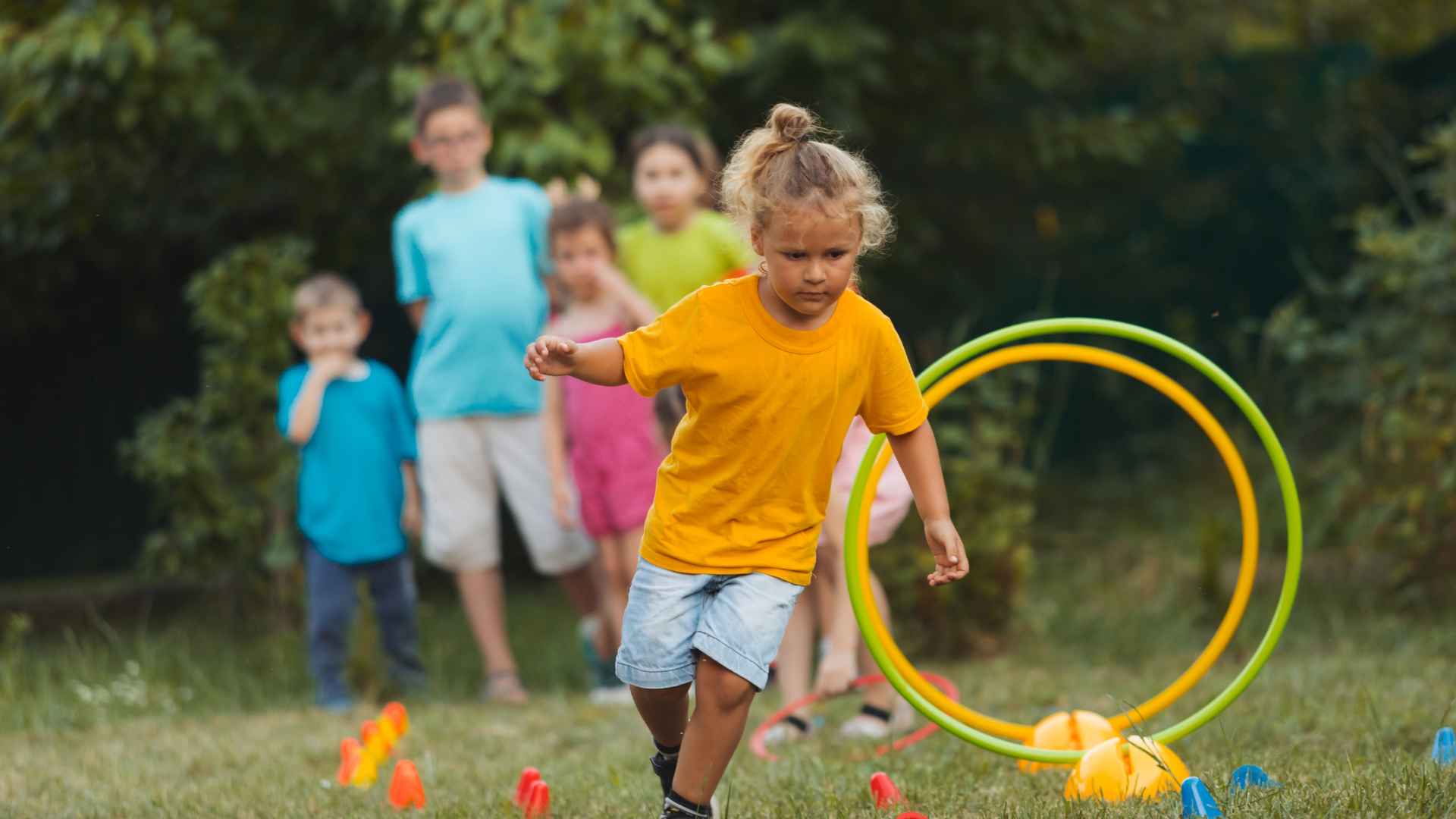
The short answer is more than most kids currently get, but there is no single magic number of outdoor minutes in the research. What does exist is a physical activity target from the CDC, which recommends kids ages 6 to 17 get at least 60 minutes of moderate to vigorous activity every day.
For preschoolers ages 3 to 5, the guidance is simply that they should be active throughout the day in whatever way fits their routine. Outdoor time is not the only way to hit those numbers, but it is one of the easiest, since kids naturally move more outside than they do in a living room.
If you want a fuller picture of how activity and screens fit together across ages, our guide to screen time guidelines by age covers the flip side of that equation.
The Physical Health Case for Getting Outside
The physical benefits are the most studied part of this whole topic, and they are not subtle. Kids who spend more time in active outdoor play tend to build stronger bones, better cardiovascular fitness, and healthier weight trajectories over time.
Sunlight exposure also supports the body’s vitamin D production, which plays a role in bone development in growing kids. None of this requires a gym membership or organized sports, just regular access to a yard, a sidewalk, or a park.
Outdoor play also tends to involve a wider range of movement than most structured sports, from crawling and climbing to sprinting and balancing. That variety helps build coordination and motor skills that a single sport rarely covers on its own.
What Outdoor Play Does for the Developing Brain
Play is not just downtime for a kid’s brain, it is active construction work. Zero to Three describes play as the way children figure out how the world works, starting from infancy.
Outdoor settings add variables that indoor play cannot fully replicate, including uneven ground, changing weather, and unpredictable materials like sticks and mud. Navigating that unpredictability builds problem solving skills in a way that a flat living room floor rarely demands.
Kids who play outside also get more practice with cause and effect in real time, like noticing that a steeper hill makes a ball roll faster. That kind of hands on feedback loop is harder to replicate with a screen, no matter how well designed the app is.
Attention, Focus, and the “Nature Effect”
This is where the research gets genuinely interesting for parents of kids who struggle to focus. According to the Child Mind Institute, kids who play outside tend to be more attentive and less anxious than kids who spend more time indoors.
Researchers describe nature as offering “soft fascination,” a kind of effortless attention that lets the brain’s more effortful focus muscles rest and recover. That recovery appears to be especially helpful for kids with ADHD, who often show improved focus after time outdoors.
Emotional Regulation and Stress Relief
Outdoor play also seems to function as a pressure release valve for big feelings. Kids who move their bodies outside tend to have an easier time settling afterward than kids who have been sitting still all day.
Unstructured outdoor time gives a kid space to be loud, to run, or to just be alone with their thoughts for a minute. If meltdowns are a regular part of your evenings, our screen time meltdown tips pair well with this research, since outdoor time is often the reset that actually works.
Fresh air and movement also appear to support better sleep, which in turn makes the next day’s emotional regulation easier. It is a loop worth protecting, since tired kids and dysregulated kids tend to be the same kids.
Social Skills, Confidence, and Independent Play
Outdoor spaces tend to host looser, more improvised social play than a scheduled activity does. Kids negotiate the rules of a game, argue about who is “it,” and figure out how to include a younger sibling, all without an adult scripting it.
That kind of low stakes negotiation builds real confidence over time. It is also why a simple backyard hangout can do more for a kid’s social skills than another structured class.
If your kid needs a nudge toward that kind of play, our list of things to do outside is a good place to start.

Risky Play: Why a Little Danger Is Good
Climbing higher than feels comfortable, balancing on a log, or roasting marshmallows carefully near a fire under supervision all count as what researchers call “risky play.” It turns out this kind of play matters more than it looks.
Kids use risky play to test their own limits and learn to judge danger in a controlled way. A scraped knee from a tree climb is not evidence of bad parenting, it is often evidence of a kid doing exactly what their development needs.
Creativity and Imagination Outdoors
A stick can be a sword, a wand, a fishing pole, or a microphone, depending entirely on what a kid decides that day. Indoor toys often come pre-programmed with one use, but outdoor materials rarely do.
That open-endedness is exactly what fuels imaginative play, and imaginative play is linked to stronger problem solving and language skills later on. If you want to understand why doing “nothing” outside is not actually nothing, our piece on the benefits of boredom for kids digs into the research on unstructured time.
Screens, Nature Deficit, and What Gets Displaced
Author Richard Louv coined the term “nature deficit disorder” to describe what happens when kids lose regular contact with the outdoors. It is not a formal medical diagnosis, but it names something real, a gap between how much nature kids need and how much they get.
Every hour spent on a screen is an hour not spent outside, testing balance, negotiating a game, or noticing how a caterpillar moves. That is not an argument for zero screen time, it is an argument for protecting outdoor time on purpose.
If you are trying to shift the balance in your house without a giant fight, our screen free parenting guide for beginners walks through how to start small.
What This Means at Different Ages
Toddlers mostly need safe space to move, wobble, and explore textures like grass, sand, and water under close supervision. Preschoolers benefit from open-ended props like balls, chalk, and buckets more than any structured activity.
Elementary-aged kids start wanting games with rules and peers to negotiate them with, which is exactly the social laboratory outdoor play provides. Teens still need outdoor time too, even though it looks more like a walk, a bike ride, or hanging out at a park than “play” in the traditional sense.
Babies benefit as well, even before they can walk, since simply being outside exposes them to new sights, sounds, and textures. A blanket spread out on the grass counts as outdoor play at that age, no equipment required.
Simple Ways to Build in More Outdoor Time
You do not need a national park to make this work, a driveway or a scrappy patch of grass is enough most days. Start by protecting one predictable outdoor window a day, even 20 minutes, rather than waiting for a free afternoon that never comes.
Keep a low-effort outdoor bin by the door with chalk, a ball, and bug jars so getting outside does not require a production. A few small, low-pressure invitations tend to work better than one big announcement that it is time to go outside now.
Weather is rarely the real obstacle it seems like, since the right layers make most conditions workable for a short outdoor stretch. A ten minute walk in light rain often does more for everyone’s mood than another ten minutes spent negotiating over a screen.
Frequently Asked Questions
How much outdoor time does a child need each day? There is no single required number, but the CDC recommends kids ages 6 to 17 get at least 60 minutes of daily physical activity, much of which can happen outside.
Does outdoor play really help with focus and attention? Yes, research summarized by the Child Mind Institute links time in nature to better attention and lower anxiety in kids.
Is risky outdoor play actually safe? Supervised risky play like climbing or balancing is considered developmentally valuable, not dangerous, when a child is given reasonable freedom within safe limits.
What if my kid says outdoor play is boring? Boredom is often the doorway to the imaginative play that makes outdoor time valuable in the first place.
Do older kids and teens still need outdoor time? Yes, outdoor time continues to support mood, focus, and physical health well into the teen years, even when it looks like a walk instead of a game.

The Bottom Line
The research is not subtle. Outdoor play supports kids’ bodies, brains, and emotional regulation in ways that are hard to fully replicate indoors.
None of this means banning screens or feeling guilty about a rainy week stuck inside. It just means outdoor time deserves the same intentional space on the calendar that screen time already gets by default.